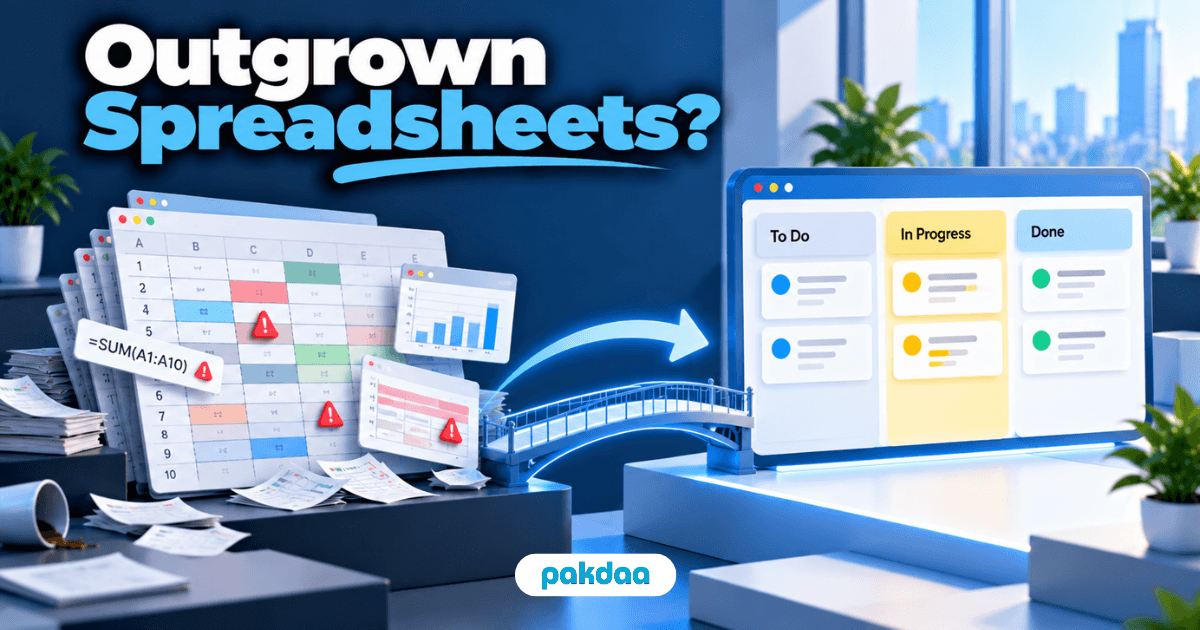
You know the drill. A client wants to see their leads, so you drop the details into a Google Sheet, hit share, and send the link. Done. Except it is not done, it is a problem you just handed to your future self.
The shared spreadsheet is the default way agencies report leads, and it quietly chips away at how professional you look and how safe your client data is. When it comes to sharing leads with clients, a link to an editable sheet is the lazy option, not the right one. Clients deserve, and increasingly expect, a private portal.
This is not the broad case for portals, we made that in our guide to why your agency needs a client portal. This is specifically about why the Google Sheet handoff has to go.
Why the Google Sheet became the default
It is easy to see the appeal. Sheets are free, instant, and everyone already knows how to use one. When a client asks to see their leads, sharing a sheet is the path of least resistance.
But easy is not the same as right. A spreadsheet was built for you to crunch numbers, not to be a client-facing, always-on, secure reporting product. Used as one, its cracks show fast.
What is actually wrong with the sheet handoff
Line the problems up and the pattern is clear: a sheet was never designed for this job.
The access problem
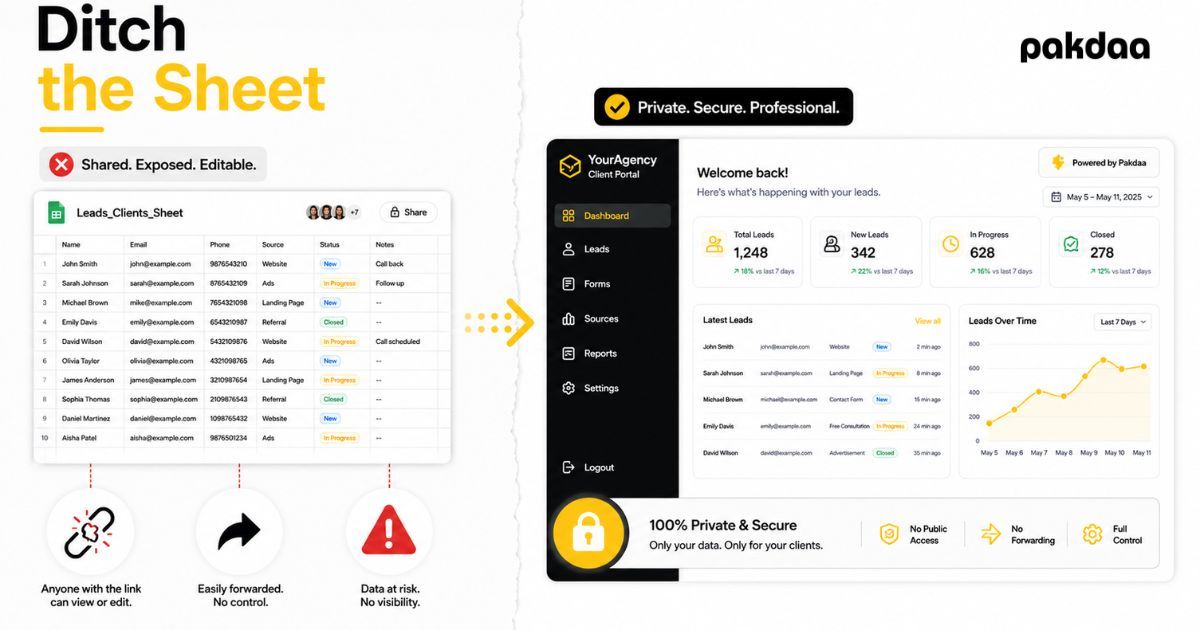
A shared sheet link is only as private as the least careful person who has it. Clients forward it to colleagues, it sits in email threads forever, and you have no real control over who ends up looking at lead data. That is a genuine data-handling risk, not just an inconvenience.
The editable problem
Give a client an editable sheet and eventually someone re-sorts it, deletes a column, or overwrites a cell. Now your source of truth is corrupted, and you may not even notice which lead went missing.
The professionalism problem
This one is subtle but costly. A spreadsheet handoff reads as amateur. It says "we threw this together" rather than "this is a service we built". Clients paying premium fees notice when the deliverable looks like a file dump.
The workflow problem
A sheet is static. There is no status, no live update, no sense that leads are arriving now. That kills urgency, and urgency wins deals. Leads engaged within five minutes qualify far better than those reached after 30, per research widely cited from Harvard Business Review. A sheet nobody is watching does not drive fast follow-up.
The trust and speed cost
Put those together and the spreadsheet quietly costs you twice. It makes your agency look less professional, weakening the trust that keeps clients paying. And it slows everyone down, because a static file does not prompt anyone to act. The very thing meant to prove your value ends up undercutting it.
The fix: a private lead portal
The professional replacement is a private, branded portal where each client logs in and sees only their own leads, live. Same information the sheet held, delivered as a secure product instead of a shared file. It solves every problem above at once: real access control, nothing the client can break, real-time updates, your branding, and no exposed structure. The full argument and feature list is in our client portal guide.
When is a sheet actually fine?
To be fair: for a tiny internal list, a quick temporary check, or your own tracking, a sheet is perfectly good. The problem is only when it becomes the client-facing deliverable. If clients are logging into a spreadsheet to see their leads, it is time to graduate.
How to move off the sheet
You do not have to rebuild everything overnight. Here is the path.
Step 1: Centralize submissions
Get every client's leads flowing into one central store instead of manually maintained sheets.
Step 2: Scope data per client
Add access control so each client can only ever see their own leads, replacing the forwardable link.
Step 3: White-label a portal view
Put a branded portal in front of the store so clients see your agency's product, not a file.
Step 4: Show leads in real time with status
Surface leads live with statuses clients can follow, so it drives action instead of sitting static.
Step 5: Give secure logins
Replace the shared link with proper authentication so lead data is actually protected.
Step 6: Retire the sheet
Once clients are on the portal, stop sharing the sheet. Keep spreadsheets for your own internal work only. This is the same reporting upgrade we describe in our agency form playbook.
The bottom line
The Google Sheet handoff feels harmless because it is easy, but it leaks access, invites broken data, looks amateur, and kills urgency. When you are sharing leads with clients, a forwardable, editable file is not good enough. A private lead portal delivers the same data as a secure, branded, real-time product that protects your client and elevates your agency. End the spreadsheet handoff. If you want a portal built to replace it, that is exactly what our team does.
Still handing clients a Google Sheet of leads?
We will replace the spreadsheet handoff with a secure, white-label client portal, real-time leads, proper access control, and your branding. Free to scope.
Book a free portal consult