Here is a question that makes most business owners go quiet: of everything you spent on ads last month, which specific ad actually brought in paying customers?
Most cannot answer it. The money went out, some leads came in, and the connection between the two is a guess. That gap is expensive, because you keep funding ads you cannot prove work and cutting ones that might.
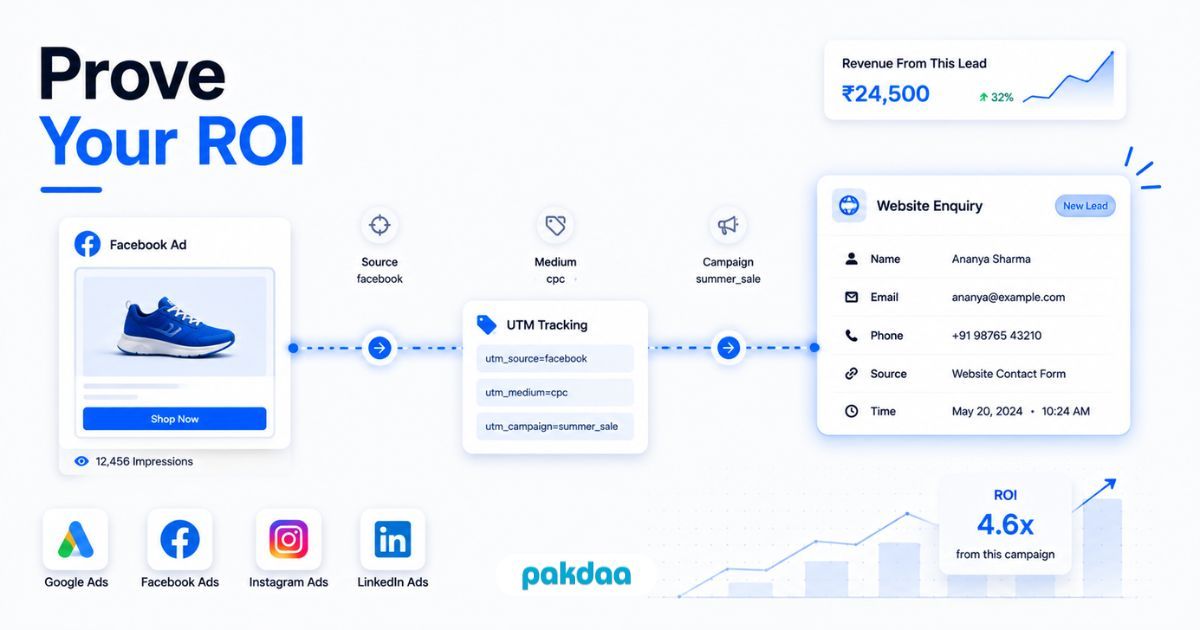
Marketing attribution closes that gap. It ties each website enquiry back to the exact ad, campaign, or channel that produced it, so you judge spend on real revenue instead of a hunch. And it is not some enterprise-only setup. With the right tags and a form that captures the source, any business can do it.
Why you cannot prove ROI right now
Three things break attribution for most businesses. Usually all three at once.
The enquiry arrives with no source attached
A lead fills your form and you get their name and message, but nothing about how they found you. Was it the Google ad, the Instagram campaign, or an organic search? The form did not record it, so the trail is already cold.
Platform numbers do not match reality
Google and Meta each report conversions their own way, and both tend to claim credit for the same lead. Add privacy and cookie changes that make platform tracking less reliable, and the dashboards rarely agree with your bank account. You need your own first-party record, not just their version.
Last-click hides the real journey
A customer might click an Instagram ad on Monday, search your name on Wednesday, and enquire on Friday. Simple tracking credits only that last step, so the ad that actually started it gets none of the credit and looks like a waste.
What marketing attribution actually is
Attribution is simply the rule you use to assign credit for a sale across the touchpoints that led to it. Different rules give different pictures.
Do not overthink the model at the start. For most small businesses, capturing the source at all is 90% of the win. You can refine the model later once the data is flowing.
How to attribute every website enquiry to a specific ad
Here is the full setup, in order. None of it needs a big budget.
Step 1: Tag every campaign link with UTMs
UTM parameters are little tags added to the end of a link that tell your analytics where a visitor came from. Every ad, email, and social post should use them, built with a free tool like the Google Campaign URL Builder. Here are the five you use.
Step 2: Capture the UTMs inside your form
This is the step most businesses miss. When a visitor lands on your site, their UTM tags need to be read and dropped into hidden fields on your contact form. Then, when they submit, the source travels with the enquiry instead of being lost.
Step 3: Store the source with every enquiry
Save the UTM data alongside each submission in your records, not just in the notification email. That way every lead in your system carries its origin. This builds on the same backup thinking we covered in our guide to the true cost of lost web leads: if it is not stored, it does not exist.
Step 4: Connect the enquiry to the outcome
Attribution only proves ROI when you close the loop. Mark which enquiries became customers and how much each was worth. Now every sale points back to the ad that created it, and every ad has a revenue number attached.
Step 5: Build a simple ROI view
Pull it together in one sheet or dashboard: spend per campaign against revenue per campaign. You do not need fancy software to start. A single table that shows cost and return per source already puts you ahead of most competitors.
Calculating ROI once the data is flowing
The formula is simple. ROI is revenue from a campaign minus its cost, divided by its cost. Here is what a clear view looks like.
Look at that table and the decisions make themselves. Retargeting is quietly the best return, Instagram brings volume but weaker conversion, and Search is a solid workhorse. Without attribution, you would be guessing at all of it.
This is also why capturing every enquiry matters before you can measure anything. If leads are slipping away unrecorded, your ROI numbers are wrong from the start. We covered how to plug those gaps in our guide to never missing a customer enquiry.
The bottom line
Marketing attribution turns your ad spend from a leap of faith into a number you can defend. Tag every link, capture the source inside your form, store it with each enquiry, and tie the outcome back to revenue. Do that, and you stop asking "is this working" and start knowing exactly which ads pay, which do not, and where the next rupee should go. This is the kind of tracking and automation our team sets up for businesses that are tired of guessing.
Want to know exactly which ads make you money?
We will set up end-to-end attribution on your site, from UTM tagging to source capture to a clear ROI view, so every enquiry ties back to the ad that made it. Free to scope.
Book a free attribution audit