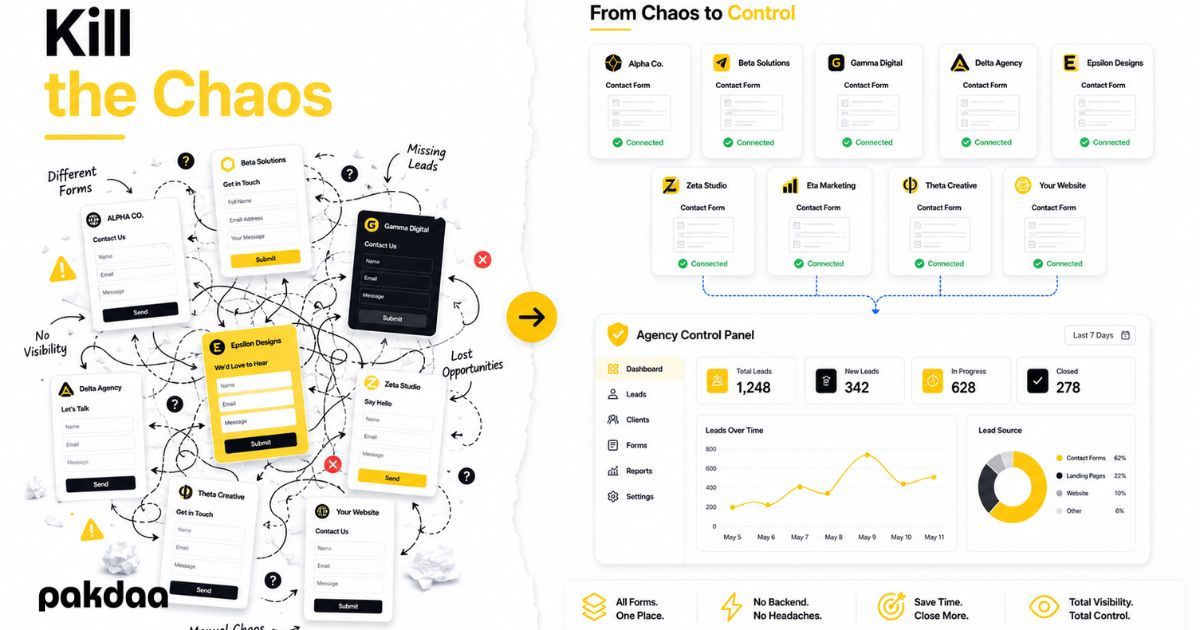
Here is an uncomfortable truth for any agency: when a client's contact form quietly stops working, it is your problem, not theirs. They see missed leads and a site you built. You get the angry call. The fix might take five minutes, but the damage to trust is already done.
Multiply that across every client you run, and form management becomes a slow reputation risk hiding in plain sight. Not because the technology is hard, but because there is no process. To manage client forms across many sites without the chaos, you need an operational playbook, not just better tools.
This is that playbook. How to standardize, onboard, own, monitor, and report on client forms so lead capture becomes a service you deliver, instead of a fire you keep putting out.
Why form management descends into chaos
The chaos is rarely technical. It is operational.
Every client site got set up slightly differently, so nothing is consistent. No single person owns "are the forms working" across the portfolio, so everyone assumes someone else is watching. Nothing monitors the forms, so failures are invisible until a client notices. And the whole thing is reactive: you only touch a form when something breaks. Small gaps, repeated across many clients, add up to constant low-grade chaos.
The tooling side of this, one central store and dashboard, we covered in our guide to managing 100+ forms from one dashboard. This post is about the process that sits on top of that tooling.
The playbook: turn it into a repeatable service
Five moves take you from fire drill to system.
1. Standardize how every client form is built
Chaos starts with variety. If every client's form is wired differently, every one fails differently and needs its own investigation. Pick one reliable pattern, same reliable delivery, same storage, same spam protection, and apply it to every client. Consistency is what makes the other four steps possible.
2. Onboard each new client form with a checklist
Every new client site should pass the same checklist before it goes live. No exceptions, no "we will sort the form later". A checklist is boring and it is exactly what stops the slow drift into chaos.
3. Assign clear ownership
Shared responsibility is why leads go cold. For each client, name one person accountable for their forms and leads, and set a simple rule for how fast enquiries get actioned. Speed is not optional: leads engaged within five minutes qualify far better than those reached after 30, per research widely cited from Harvard Business Review. A lead sitting unnoticed on a client's site is a lost deal they will blame on you.
4. Monitor every form proactively
This is the step that protects your reputation most. Set up monitoring so a form that goes quiet or starts failing raises an alert to you, before the client ever notices. Finding and fixing a dead form the client did not know about turns a potential complaint into a moment of trust. It is the difference between "our form was broken for a month" and "our agency caught it in a day".
5. Report captured leads back to clients
Lead capture done silently looks like nothing. Lead capture reported looks like value. Send each client a simple regular summary: how many leads came in, from where, and the trend. Better still, tie those leads back to the campaigns that produced them, which we cover in our guide to proving marketing ROI. This is what turns form management from an invisible cost into a reason clients renew.
The payoff: from fire drill to service
Run these five moves and the whole picture changes. Forms stop breaking silently, leads stop slipping, and the panicked client call disappears. More importantly, you can now stand in front of a client and show them exactly how many leads you captured this month. Form management stops being a liability and becomes something you get paid to do well.
The bottom line
Managing client forms across many sites is not a tech problem, it is an operations problem. Standardize the build, onboard with a checklist, assign real ownership, monitor proactively, and report the results. Do that and the chaos dies, replaced by a repeatable service that protects your reputation and earns retainers. If you would rather have the tooling and process set up for your agency, that is exactly what our team does.
Client forms feeling like constant firefighting?
We will set up the tooling and the process, standardized builds, central capture, monitoring, and client-ready lead reporting, so your agency runs form management as a service, not a scramble. Free to scope.
Book a free ops call